

There was no way I was going back to New York.
Even though the thought crossed my mind, I had to remind myself why I came here—and what I left behind.
I was just shy of twenty-four when I packed my life into a few suitcases and moved to Los Angeles with my twin brother. We came for several reasons: for me, the chance to pursue acting and screenwriting; for him, to dive deeper into animation and contemporary art. Together, to build on the momentum of our brand, Dare Dollz—the stylish, sexy clay dolls we created out of boredom that unexpectedly gained a loyal online following and quietly launched my career as an art director. More than anything, though, we moved to put space between ourselves and our toxic family.
We didn’t have much saved, but enough to sublet a large room in Koreatown from a small man with a needy cat. Imagine two grown adults crammed into one room—easels, canvases, too many clothes—and the constant scratching and meowing of a stranger’s cat outside the door. My brother and I were close, but this was testing our limits.
The first six months were a blur of commissions, gigs, and constant adjustments. We were doing okay financially, but Los Angeles, like New York, is expensive—and one job never feels like enough to sustain a decent life. I worked part-time as a nanny. He assisted an event planner in Beverly Hills. In between, we cranked out stop-motion animated commissions for musicians and brands, while taking on soul-sucking gigs like customizing basketballs at bar mitzvahs. We were grateful not to be broke, but we were pouring our creativity into everyone else’s visions and saving none for our own. I neglected auditions and writing altogether. We were too drained to chase the dreams we had moved for.


In L.A., most creatives are dealing with the same struggle—working multiple gigs while waiting for the moment they can finally afford to invest in their own dreams. And although artists make up nearly 5% of the city’s workforce—more than in any other U.S. city—that visibility doesn’t guarantee sustainability.
It’s a city full of side hustles, where working doesn’t mean you’re succeeding—it just means you’re still surviving.
So we decided to put the gigs and commissions on hold. It was time to invest in ourselves, our characters, our world. We started developing the Dare Dollz comic book and leaned into selling merchandise—T-shirts, prints, and accessories. The merch moved surprisingly well. It was exhausting in its own way, but at least it was pushing our brand forward, not just paying the bills.


Then, the week before Christmas in 2019, a life-changing email landed in our inbox.
The sender was the son of an A-list entertainer. Let’s call him Marcus. He wanted to hire us as lead designers for an animated project called Mofey’s Trap — a claymation series about a chaotic world inside a clogged bathroom drain, inhabited by wisecracking bugs and gangster critters. The hook was that his dad, a comedic giant we all grew up watching (and who my grandparents still watch daily), with a net worth that could have bought the entire street I lived on, would voice the main character. And of course, there was the money.
At our first virtual meeting, Marcus gushed over our portfolio. He told us he’d been a fan, had bought our merch, and recognized our influence in the wave of internet-born artists. He buttered us up—a little too good, when I think about it now. We were talking sets, characters, storyboards—the whole thing. After an hour of bouncing ideas, he offered us the job.
It was the kind of offer that makes you believe God has been listening. The cons were obvious: Dare Dollz and every other project we cared about would have to pause. But the pros? Exposure, money, bragging rights for our grandparents—and maybe even a new apartment where we wouldn’t have to sleep within arm’s reach of each other. The pros won easily.
I sent an agreement with an invoice: $6,280 for conceptualizing and designing the characters and set. Marcus signed off and paid fifty percent upfront. Just like that, the fire was lit.
We locked in. Days belonged to our jobs, nights and weekends to Mofey’s Trap. We pulled all-nighters sculpting insect-like clay figures with microscopic details, painting glistening eyes, hand-stitching tiny outfits. As we neared completion, the set began to feel alive. Each character had a story, and we would imagine which entertainers' voices could bring them to life.
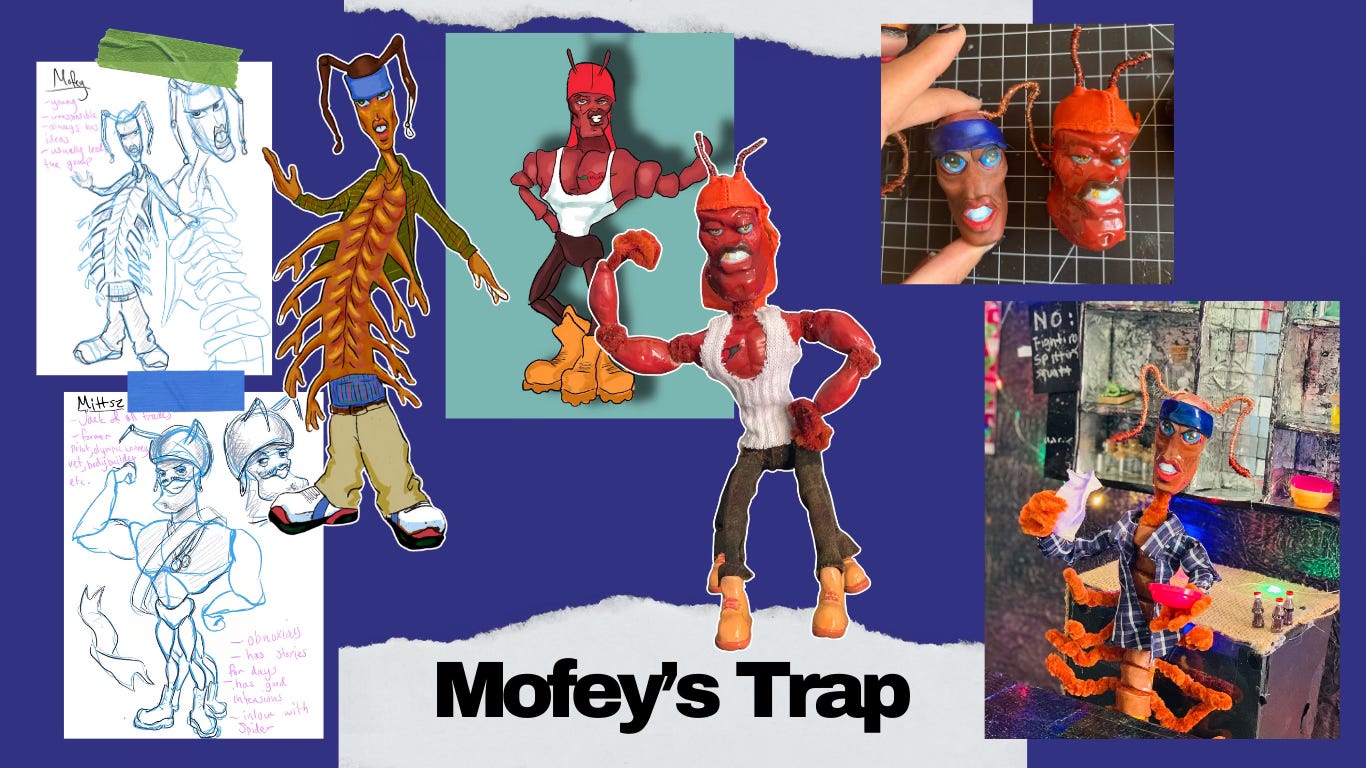
Marcus said he liked what he saw in photos and videos, but wanted to see it in person. In February, he flew from Atlanta to L.A. and visited our “studio”—our living room, bedroom, and closet all in one. We had purchased small, cheap sofa beds from Walmart to save room and put up dividers to separate our work and personal areas. It wasn’t glamorous by any means, but Marcus seemed down-to-earth and unbothered by the marijuana-clouded hallways we led him through to get to our apartment.
He lit up when he saw the set. He was impressed but confused about how the characters would move. He didn’t understand how much labor stop-motion actually required — that animators, like us, shoot twelve to twenty-four frames for a single second, meaning nearly 1,500 frames for one minute of footage. It wasn’t something that could be done quickly. When we explained it, he shrugged, as if it were just a minor detail that could be glossed over.
He left with a few notes, plenty of compliments, and a handshake that sealed our faith in him—and in Mofey’s Trap.
For the rest of February, we worked on Marcus’s notes, fine-tuning details we thought were already solid. Communication slowed, but we chalked it up to his newborn and the headlines about a mysterious, deadly virus spreading. The news, as you know, turned out to be true — and on March 4, 2020, Los Angeles officially went into lockdown. Coincidentally, that same day, we finally heard from Marcus again. He texted that he was happy with the changes and ready to start building the rest of the team.
We were relieved. That night, we boxed everything: the dolls, the sets, the storyboards—preparing them for shipment. But before we shipped, there was one thing left to handle: the remaining balance.
I sent the final invoice. We waited for the confirmation, imagining the relief of seeing those numbers hit our account—groceries, rent, a little breathing room during the apocalypse.
Instead of payment, there was nothing.
Nothing but silence.
Silence, and an unpaid invoice.
We didn’t harass Marcus for the money. Instead, we rationalized his silence. Everyone was scrambling in those first weeks of lockdown. Grocery shelves stripped bare, body counts on the news. Maybe clay figures weren’t his priority.
Like most people, we lost our jobs. Sure, unemployment helped, but without the gigs that padded our income, we were fucked. Our landlord didn’t care about pandemics. Groceries didn’t either. Asking our mom for a loan felt like swallowing pride—especially since we’d left home on a sour note. (That’s another story for another essay.)
As weeks dragged on, the uncertainty of the future and the state of the world got to me. Panic attacks hit like waves, each one pulling me into a deeper state of depression.
Eventually, we caved and asked our mom for help. Her loan bought us time, but we knew we needed something else and fast.
By late April, masks had become a fashion statement. My brother had a knack for customizing clothes—hats, shirts, sneakers—anything that could hold paint. His mask was no different. He painted a wide, gleaming smile with grillz, inspired by Peewee Longway. When he put it on, the illustrated grin seemed to belong to him. It wasn't just stylish—it was genius.


I suggested we sell them, and he enthusiastically agreed. Within hours of posting online, DMs exploded with orders. We turned our kitchen table into a factory line—painting, packaging, labeling. Demand surged so fast we switched to printing to keep up. Hundreds sold, then hundreds more.
Those masks paid the rent, filled the fridge, and gave us back something we hadn’t felt in months: stability.
At the same time, commissions began trickling back in. With live-action productions shut down, brands scrambled for remote content. Animation didn’t need a set—it needed us. As The Ringer put it: “Animation is one of the only sectors in the entertainment industry that hasn’t been forced to shut down during the pandemic, leading to a boom for a format already on the upswing.” Suddenly, animators had the upper hand. For once, we weren’t just surviving—we were succeeding.
By September, we had saved enough to move into a three-bedroom, 1,700-square-foot duplex. We turned the spare into a studio. We were moving on up.
Then, on September 28, Marcus resurfaced.


His message was full of excuses—COVID, a new baby. Meanwhile, his wife was on Instagram flaunting trips to Cabo and Aspen, boarding private jets in designer sweats. She was no different from other celebrities flaunting wealth at the end of the world — except her husband owed us money.
An amount that was pocket change to them, but could do wonders for us.
I thanked him for reaching out, re-sent the invoice, and waited.
Once again—
Silence, and an unpaid invoice.
A year later, mask sales slowed as the world reopened, but Dare Dollz kept growing. We launched new merch, rented our home as a production space, and—finally—neared completion on our long-awaited comic book. For the first time since moving to L.A., it felt like things were falling into place.


Then came the call from our mom. I won’t go into detail, but family business pulled us back to New York. But weeks away from L.A. meant paused orders, lost bookings, and bills piling up. By the time we got back, we were scrambling to stay above water and had to return to our soul sucking gigs.
At that point I just needed a sign from the universe that all of this work we did wasn't for nothing and while scrolling through Instagram one day, I got it.
I saw a post of Marcus's parents celebrating his mom's fifty-seventh birthday in Paris. She was dressed in head-to-toe Chanel; his dad was grinning his signature grin against the backdrop of the Eiffel Tower. That's when it hit me — we still had an unpaid invoice.
So I reached out.
This time, I warned him we’d pursue legal action. His reply dripped with arrogance. He called us “desperado” for pressing the issue two years later. The word stung most because, in that moment, I feared it was true. I was desperate. And I felt embarrassed for asking for the money that was owed to me. Crazy, right?
But I didn’t give up. I called a lawyer in Atlanta, who said something like:
The amount you're suing for isn't worth the time or expense. It's unfortunate, and I'm sorry I'm unable to help you.
That’s when embarrassment turned into anger.
I wasn’t just broken—I felt disrespected. Like every person who doubted me was right all along. I was drowning in regret.
Life as a full-time artist is depressing because most people don’t respect creatives.
People don’t see us as essential, but we design the logos you wear, the restaurants you dine in, the ads you scroll past, and the shows you binge. Without artists, the world is blank.
Yet too many of us starve, scraping by on gigs and unpaid invoices. And at that moment, I asked myself: “Is this really worth it?”
I didn’t mean pursuing art. I meant pursuing life.
It’s dark, but it’s the truth.
Eight weeks later, when I was Googling “storage near me” and posting our used furniture on OfferUp, an email arrived.
From Puma.
They wanted a Dare Dollz x Puma collaboration: dolls styled in classic Suedes, a custom installation, and an interactive display. At first, I thought it was a scam. It all sounded too good to be true — we’d been fooled before — but then they sent over their proposed budget, and I didn’t know our worth until that moment. I read it three times, expecting the digits to shrink each time I blinked. Still, we didn’t let ourselves get excited until a friend in management reviewed the paperwork. He legitimized it, called it a career-defining opportunity, and encouraged us to do it. We let Puma know we were on board, and they paid fifty percent upfront.
It felt like someone had thrown us (me) a life jacket in the nick of time. Thank god.
Over the next couple of months, we built and reinvested in Dare Dollz. We created stunning figures and designed an interactive display where guests could pose inside a life-sized Dare Dollz box. The most significant feat, though, was finishing our comic book just in time for the activation, so that every attendee received a virtual copy.


The activation launched April 21, 2022. The event space was transformed into a world we’d built, shoulder to shoulder with other artists of color. Family, friends, and celebrities filled the room. Standing in front of our display, my throat tightened, and my face was wet. For a moment, I thought I was drowning again. But then I realized I was crying — a happy cry, because this was it. The moment that made everything worth it.
By that October, after a year of rebuilding, my brother and I took a month-long trip through Europe. One afternoon in Bordeaux, we sat on the deck of our Airbnb surrounded by nothing but—
Silence, sunlight, and paid invoices.
For the first time in years, I felt weightless—not because the struggle was over, but because we had made it through. And maybe that’s the truth of surviving as a creative in dark times: you bend, you adjust, you obsess, and you keep going.
Octavia Butler once wrote:
“Prodigy is, at its essence, adaptability and persistent, positive obsession. Without persistence, what remains is an enthusiasm of the moment. Without adaptability, what remains may be channeled into destructive fanaticism. Without positive obsession, there is nothing at all.”
I finally understood.


Wait I want more!?!?
Wow, I felt a whirlwind of emotions reading this essay. I definitely been there, doubting my worth, shrinking myself. This was a reminder to keep going thank you Dare. I got one question though still, who the fuck is Marcus really ?????