

Editor’s note: This essay was originally written prior to the release of the recent Netflix documentary on America’s Next Top Model and is being republished with minor edits.
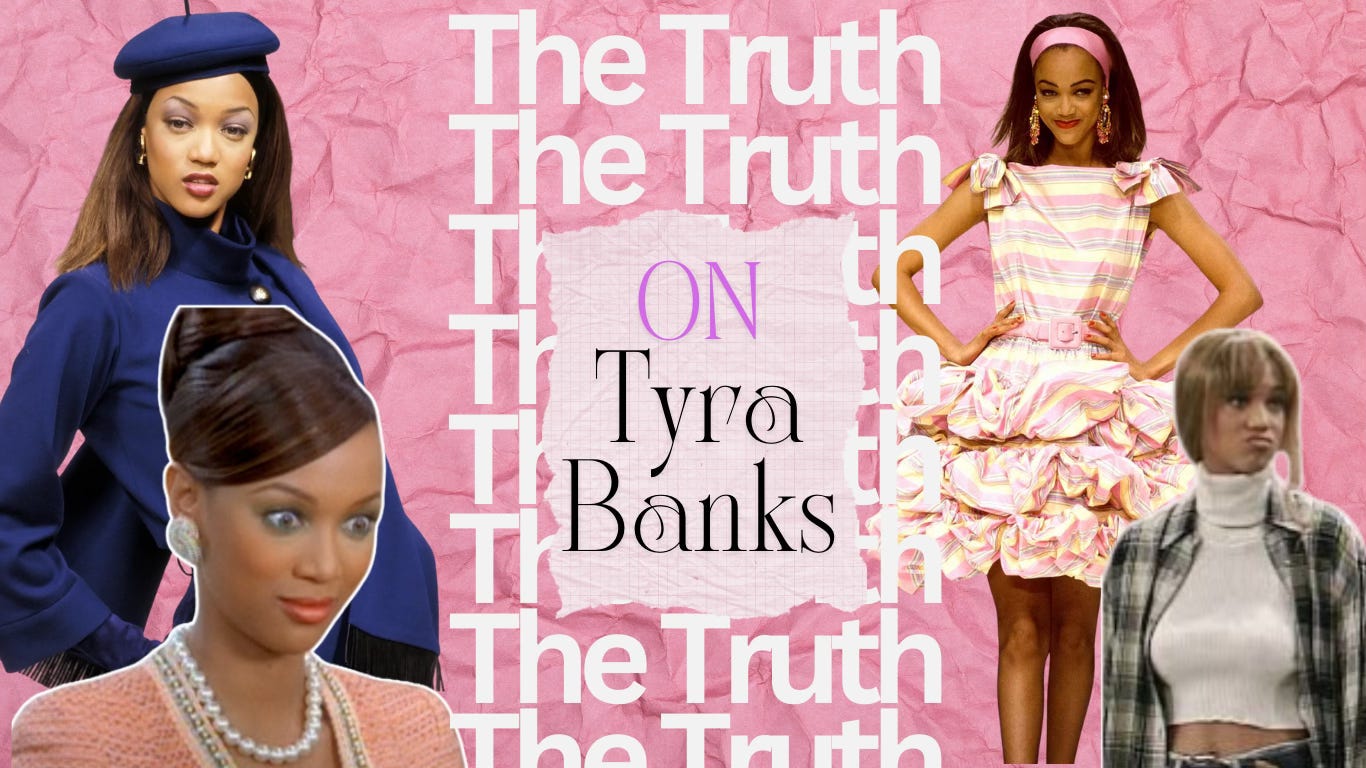
I know I wasn’t the only little girl walking around in my mom’s heels at seven years old, convinced that one day I’d be a contestant on America’s Next Top Model. And even now, I still feel grateful for Tyra Banks. Not just for teaching me how to walk in heels, but also for showing me what ambition could look like on a Black woman’s terms.
Tyra’s influence on me came in phases. I remember first seeing her as Will Smith’s girlfriend on The Fresh Prince of Bel-Air, not even realizing she was already one of the world’s most successful supermodels. Then she was Stacy in Life-Size, playing a literal Barbie come to life alongside Lindsay Lohan. I remember thinking: Wow. She’s perfect.
As I moved into my teenage years, my afternoons were filled with The Tyra Show and my evenings with America’s Next Top Model. It felt like she had done it all—runway, television, film, business. Tyra was everywhere, and she made me feel like I could be everywhere too.
Years later, when Tyra returned to TV as the host of Dancing with the Stars, I tuned in immediately. It was the first time I had ever watched the show, and I was excited to see Tyra back on my screen, but the internet wasn’t celebrating with me. People were angry.
In recent years, Twitter—and now think-piece culture at large—has been attempting to cancel Tyra Banks over resurfaced ANTM clips. Critics argue that she was overly harsh, particularly toward women of color, and that her judgment crossed the line from constructive criticism into cruelty.
I revisited episodes myself. I won’t pretend Tyra’s approach was always perfect because it wasn’t. Still, context matters.
To understand, remember: ANTM was a reality television show—edited for drama and engineered for conflict. It focused on fashion, one of the most competitive, unforgiving, and historically racist industries. Most significantly, Tyra was pioneering—building a modeling empire and a mainstream media platform simultaneously as a Black woman, at a scale no one had achieved before.
Tyra Banks is not a villain. She is just paying the cost of being first.
Her contributions to Black history, women’s history, and pop culture are far too significant to be erased by viral clips and hindsight morality.
Let’s be clear about what Tyra did: She created and hosted the first major modeling competition show and became one of the first supermodels to host a daytime talk show. She starred as a Barbie-like lead in a Disney film and confronted industry power players on national TV. She became the first Black woman to land a solo swimsuit cover in Sports Illustrated, transitioned from high fashion to commercial stardom, built longevity in an industry that discards women as they age, and created space for future stars like Eva Marcille, Winnie Harlow, and Toccara Jones.
So yes, people can label Tyra a “toxic celebrity.” She was harsh with contestants—especially Black contestants—used spectacle on her talk show (fat suits, exaggerated segments), upheld unrealistic beauty standards, and sometimes pushed people beyond their comfort zone.
But here’s what rarely gets asked:
Would you not push harder on people you believed in?
Was Tyra cruel, or was she honest about the industry she survived?
Why are we judging her methods as if she weren’t speaking from lived expertise?
And why does Tyra receive more vitriol than her peers, when she was the one creating opportunity instead of gatekeeping it?
If the criticism was too much for some contestants, would the fashion industry—far colder and far less forgiving—have been any kinder?
Instead of canceling Tyra Banks, maybe we should cancel the fashion industry that trained her, rewarded her toughness, and profited from those same impossible standards.
Tyra didn’t invent the system. She navigated it. She survived it. And then she opened the door behind her—inviting future generations to walk through, grow, and redefine what is possible.
Tyra Banks isn’t the villain people want her to be. She is flawed, like all of us—but not all of us have contributed so much to a community. Our willingness to tarnish her legacy for not being perfect is a testament to our unrealistic expectations of women. As I wrote in We Deserve Better Than This, “women are expected to arrive fully formed, unblemished, and exceptional.” No room for flaws, trauma, or growth. I suppose that, too, is the cost of being first.
This was soooo good!