



Warning: This essay contains spoilers for Season 1 of Furious and discusses sexual assault, child sexual abuse, sex trafficking, and domestic violence.
Watching Hulu’s latest crime thriller, Furious, has captivated and enraged me every Monday night for the past six weeks.
The show begins like your typical crime drama, where a team of FBI agents is tasked with hunting a vicious serial killer. But when the agents learn that the serial killer is a woman, that’s when things start to get interesting.
Catherine Grace, played by Lola Petticrew, tortures and kills the powerful men connected to the sexual abuse she endured as a child. Catherine is brilliant, terrifying, and, at times, disturbingly easy to root for.
Catherine is a killer, yes, but she is also a victim—as is every woman at the center of this series. They’ve all been victimized by a man, an institution, or, frequently, both. And each has developed unconventional, sometimes destructive ways of coping with her trauma.
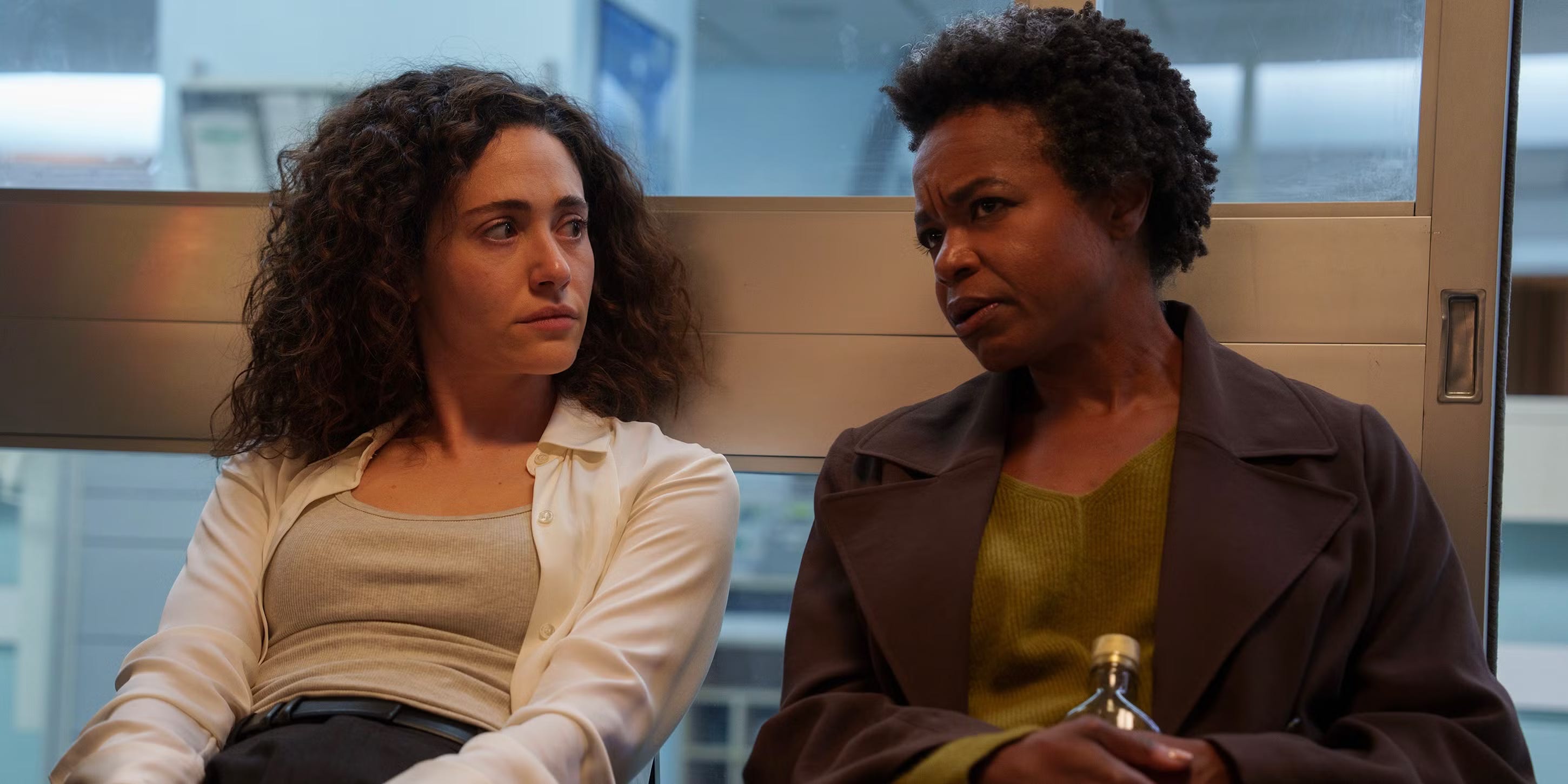
Alice Black, played by Emmy Rossum, is the FBI agent hunting Catherine. She is also a survivor of domestic violence. Her ex, and former colleague, used to drag her out of the shower to beat her. And when Alice reported his abuse, the department treated her like a traitor for speaking against one of their own. Alice’s trauma follows her into every part of her life. She is isolated at work, afraid to shower alone, and seeks rough sex with guys she meets on an app.
Nora Washington, played by Quincy Tyler Bernstine, leads the FBI’s sex-crimes unit. She has spent so long battling racism and misogyny inside the bureau while absorbing the horrors of crimes committed against children that she has become a cynical, high-functioning drunk. We watch Nora finally let down her guard as she drunkenly belts Meat Loaf’s “I’d Do Anything for Love (But I Won’t Do That)” in a tropical button-up—a stark contrast to her usual dark, buttoned-up FBI wardrobe.
Catherine, Alice, and Nora are very different women, but they’re all living with the same unbearable knowledge that the system they were taught to trust does not protect women equally, and oftentimes it does not protect them at all. And the way each woman copes with this reality is what makes this series painfully alluring.
In the first episode, Nora tells Alice a version of Medusa’s story in which Medusa, once a beautiful young priestess, was raped by Poseidon in Athena’s temple. Athena then punished Medusa (but not Poseidon) by turning her hair into snakes and making her gaze turn anyone who looked at her to stone.
Medusa was violated but became a monster, while Poseidon remained a god.
That same misogynistic logic drives Furious: men can violate women and remain powerful, while the women they violate are punished and judged for what their trauma turns them into.
Catherine is clearly the Medusa of this story.
And Jay Easton, played by Peter McRobbie, is Poseidon, the most powerful man and the most dangerous. Easton has been molesting and abusing girls for decades and getting away with it until Catherine Grace comes along. And she knows men like him do not operate alone. They require an entire ecosystem.
They require recruiters (like his own daughter) who deliver vulnerable girls. They require doctors and medical professionals willing to treat victims without asking too many questions. They require police officers and federal agents willing to look away. They require friends, relatives, and business associates who may know of their cruelty but value their proximity to power more than the safety of women. That is why Catherine’s fury is not reserved solely for her abuser.
Furious is very intentional about displaying how deeply misogyny is embedded in our legal system and our society. The callous commentary made by some people supposedly responsible for investigating violence against women will infuriate you. Police officers, federal agents, and even medical examiners speak about certain victims—particularly sex workers and girls who were trafficked—as though exploitation made them less deserving of dignity.
It is one of the most devastating truths that Furious uncovers. Our institutions prefer a clean victim: one who leaves no room for doubt. One who never placed herself in a vulnerable situation, trusted the wrong person, or made a decision that could later be used against her. Even then, she may never receive justice, because the system wasn’t built to protect women.
I was twenty-two when I learned just how true that is.
After a long day of babysitting, I met a man from Tinder and two of his friends, a married couple from Jersey, for drinks. They were coming from a concert at MSG and seemed like a cheerful bunch. After one round, we all decided to go back to his apartment to smoke on his rooftop.
Shortly after we arrived, his friends said they needed to hurry home to relieve their sitter. They said their goodbyes, and then it was just us.
We went downstairs and sat in his kitchen while he rolled another joint. He was clearly the Grateful Dead’s biggest fan; photographs from concerts decorated his apartment. He was definitely older than his profile suggested, but he had that old-school-rocker look about him, and I didn’t mind it.
He put on a record and sat beside me on the couch. We smoked and made out before he offered to give me a massage.
I lay on my stomach wearing nothing but my underwear. He rubbed oil across my back while I closed my eyes and relaxed. As he neared my lower back, he paused. I assumed he was reaching for more oil.
Then he quickly pulled my underwear to the side and penetrated me.
“What the fuck are you doing?” I yelled, lifting myself as though I were doing a push-up to get him off me.
“I’m sorry. I’m sorry,” he said. “I got carried away.”
“Yeah, you absolutely did.”
I grabbed my clothes and got dressed. He began to panic and walk toward me, apologizing profusely.
“Don’t come near me.” He froze. We were both silent for a moment.
I had never been more afraid of someone. My heart was beating so fast.
What if he kills me?
I tried to act calm so I could make it out alive. Then, as I was nearing the door, he asked if he could give me money for a cab home, as though cab fare could pay for what he had done.
I refused and hurried out, hoping he could not sense enough of my fear to try to stop me.
Once the outside air hit me, my heart began to slow down. I took a breath and prayed. Then my mind tried to rationalize what had just happened.
I shouldn’t have stayed once his friends left. I shouldn’t have taken off my clothes. I put myself in danger.
I knew none of this was my fault. Still, some part of me was trying to determine what I had done wrong.
I immediately went to the nearest police precinct. I had learned enough from Law & Order: SVU to know that evidence needed to be collected as quickly as possible.
The first officer I spoke to placed me in a room, where I waited for two more officers, one male and one female. Then they asked me what felt like a million invasive questions.
What I remember most clearly is how often the female officer used the word if.
If he raped you.
If he assaulted you.
“Do you have his profile?” she asked.
I opened the app, and, of course, he had unmatched me.
“Always screenshot their profiles,” she told me, as though I should have been better prepared to be assaulted.
The details of that interrogation are blurry now, but I will never forget her energy. It felt as though I had made every wrong decision, as though I had placed myself in that situation.
I wondered whether they believed me.
Where was Detective Benson when I needed her?
Then a female captain entered the room. She was warmer and more delicate with me as she explained what would happen next.
I rode in an ambulance back to the scene of the assault. It was two in the morning, and police cars and an ambulance surrounded his apartment building.
Through the window, I watched him walk out of his home in handcuffs. I confirmed that it was him.
An officer spoke into his radio.
“Take him in.”
For a moment, I felt relieved.
They had him.
I felt proud of myself for being brave enough to report him.
The following day, I received a call from an assistant district attorney assigned to evaluate the case. He scheduled a meeting, and when I arrived at his office, I told the entire story again.
“What do you want out of this?” he asked.
I didn’t know how to answer. Was I supposed to have researched the possible punishment for rape before coming to the meeting?
“I just want to make sure he won’t do it to anyone else,” I said. “Whatever that looks like.”
For weeks, I heard nothing from the ADA or the police department. Eventually, I called the office myself. His assistant said he would call me back.
When he finally did, I was sitting on a bench alone in Central Park. I could tell by the tone in his voice that he did not have good news for me.
He told me that the office would not move forward with my case.
First, my emotions went still. Then the truth settled over me and I lost it.
I started crying and screaming in the middle of the park, scaring all the pigeons away. I couldn’t rationalize why they refused to move forward with my case.
I had reported him immediately. I did a rape kit. I had done everything survivors are told they are supposed to do.
And it still was not enough.
I was humiliated. I was furious.
I am still furious.
So when it comes to Catherine, I understand her fury.
There are days when I have wondered what it would feel like to hurt the man who hurt me. Not because violence would undo what happened. But when someone traumatically alters your life and then continues living theirs without consequences, it can leave you with a fury that never completely goes away.
Understanding Catherine’s fury does not mean I condone her actions. Not everyone harmed by Catherine was responsible for what happened to her, and her actions traumatized people beyond the men she intended to punish. But when institutions repeatedly fail victims, you start to ask yourself: what if I took matters into my own hands?
Nearly half of women in the United States have experienced some form of contact sexual violence in their lifetime. More than one in five have survived completed or attempted rape.
Sometimes, while riding the train, I look around the car, counting every woman I see, and wonder:
Did it happen to her too?
How many of us are carrying some version of Catherine’s fury?
The finale of Furious answers that question by revealing that Catherine is not the only woman carrying this kind of rage.
For most of the season, Alice believes she is fundamentally different from Catherine—until she confronts Jay Easton and he recognizes her from a recording of her childhood abuse. Alice then suffocates him and lies about his cause of death.
Alice is supposed to be the series’ hero. But she is also a victim. And she was furious.
That fury turns her into a monster.
Victim. Hero. Monster.
By the end of the season, none of those labels belong exclusively to any one woman.
Furious understands that female rage does not emerge from nowhere. It is cultivated by every report dismissed, every case buried, every predator protected, and every victim interrogated as though she were the one who committed a crime.
Many real-life monsters like Jay Easton go their entire lives without facing consequences because the system protects them to protect itself. Women are not afforded that same protection. Catherine certainly was not.
In the end, Catherine goes to prison, where she will be forced to answer for her actions.
Nora and Alice continue working within the institution that has failed them time and time again.
Jay Easton dies having never faced any legal consequences for the lives he destroyed.
The violated woman became a monster. The man who violated her remained a god.
And that makes me furious.
This hit me hard.
You did everything we tell survivors they are supposed to do. You reported him immediately. You went through the questions, the rape kit, the retelling, all of it. And then the system still handed the consequences back to you while he got to keep living his life.
I am so sorry you had to carry that.
Your line about knowing it was not your fault while still searching for what you had done wrong stayed with me too. That instinct to put ourselves on trial after someone else hurts us is something I know far too well.
And I think that is part of what Furious understands so well. Catherine’s rage does not appear out of nowhere. Neither does Alice’s. The show lets us understand the fury without asking us to pretend everything done in its name is justified.
“Victim. Hero. Monster.” really landed for me because the series keeps refusing to let those categories stay clean.
Thank you for trusting your readers with this story. I know this was not just a television essay. 🤍